
Fixed costs pick winners
Compliance is a fixed cost, and fixed costs fall hardest on whoever has the least revenue to spread them across. What that means for open-weights models — and why substitutability is the only hedge a buyer actually controls.
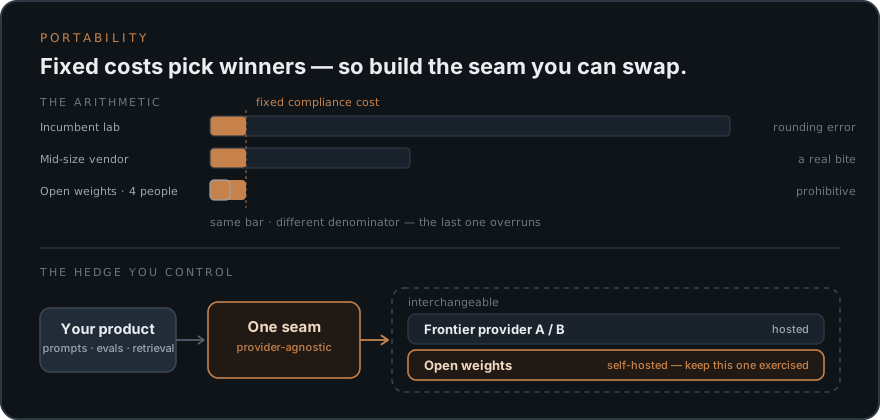
Here is a piece of economics that has nothing to do with AI and explains a great deal about it.
The cost of clearing a regulatory bar is mostly fixed. An evaluation regime, a licensing process, a safety documentation requirement, an audit — each costs roughly the same to satisfy whether you are a lab with a billion dollars of revenue or four people who released a set of weights. Fixed costs are therefore regressive: they are a rounding error against a large denominator and prohibitive against a small one. Any threshold priced for an organization with a safety department, a legal department, and a compliance budget is, by arithmetic rather than by design, an exclusion of everyone without one.
That is the whole argument, and it is worth separating cleanly from the argument usually made alongside it.
The structural claim, not the motive claim
Several of the largest model providers have called publicly for regulation of frontier AI. The common response is to read this as strategic — an attempt to pull the ladder up. We're not going to make that claim, because we can't know it and it isn't necessary.
We don't know what anyone intends. There are people at those labs who believe what they're saying with complete sincerity, and the concerns they raise are not fabricated. But intent is unknowable and, for a buyer making an architecture decision, irrelevant. What is knowable is the incentive structure and the cost structure, and both point the same way: a regime of licensing and mandatory evaluation is cheapest to satisfy for the parties who already do that work, and those are the same parties advocating for it. You can hold that observation without alleging a conspiracy, and the version that doesn't allege one is the version that's hard to dismiss.
The consequence is what matters. A model you can download, inspect, fine-tune, and run on your own hardware has no revenue line to amortize a compliance program against. Rules aimed at the frontier that attach to capability thresholds, or to distribution, fall on open weights hardest — not because anyone targeted them, but because a fixed cost divided by zero dollars is infinite.
This is not an argument against regulation
We want to be careful here, because the structural point gets recruited into a broader position we don't hold.
These systems warrant governance. There are genuine harms, some of them already happening, and "no rules" is not a serious answer from anyone who has watched an unaccountable technology scale. The relevant question is not whether to regulate but how the cost of compliance is distributed — whether a regime is designed so that a small team or a research group can clear it, or only an incumbent can. Those are different regimes with the same stated goal, and the difference is nearly invisible in a press release and decisive in a market.
Which means the concentration risk is real whether or not anyone is engineering it. And concentration risk is a thing architects are supposed to plan for.
The hedge is substitutability
You cannot control how this is regulated. You can control whether your system survives the outcome, and that reduces to one property: can you replace the model without rebuilding the product?
In practice that's the same seam we've argued for on cost grounds. One place that decides which model serves a request, rather than a provider's SDK threaded through forty call sites. Prompts, retrieval logic, tool definitions, and golden sets held as assets you own, in your repository, not encoded in a vendor's orchestration product. An eval harness good enough to qualify a replacement model in days instead of quarters — because the thing that makes substitution slow is almost never the integration, it's not knowing whether the new model is good enough at your actual work.
And then the part most teams skip: keep at least one open-weights path exercised. Not diagrammed, not planned — running, in production, for some real class of traffic. A fallback nobody has executed is a narrative, and narratives fail the first time they're load-bearing. If a local or self-hosted tier serves a real share of your volume, you will find out about its gaps on an ordinary Tuesday rather than during a crisis.
None of this is expensive if you do it while the architecture is still a draft, and all of it is expensive later. Same as every other structural decision.
Portability pays for itself before it's needed
The reason we recommend this without needing to be right about the politics is that substitutability is not a bet. It pays off in the ordinary case.
The seam that lets you swap a provider under duress is the same seam that lets you route cheap work to a cheap model, adopt a better model next quarter without a migration project, negotiate with a vendor you can credibly leave, and keep sensitive workloads inside your own boundary. Every one of those is a return you collect whether or not the regulatory picture goes the way anyone predicts. The hedge is free because it's also the good design.
We don't know what this market looks like in three years. Nobody does, including the people calling for the rules and the people objecting to them. What we can build is a system whose viability doesn't depend on guessing — where the model is a component with a replacement, rather than a foundation you poured.
Assume you'll change models. Build the seam. Then the question of who ends up allowed to sell you one becomes a procurement problem instead of an existential one.
Want an AI architecture you can still change your mind about? Start a conversation.