
Release frequency is an economic decision
Code that is written but not shipped is inventory: paid for, depreciating, and earning nothing. Why we treat deploy frequency as a business lever rather than an engineering preference.
Most organizations treat how often they ship as an engineering preference. One team ships daily, another monthly, and the difference gets explained in terms of tooling or temperament. That framing hides what is actually going on. Release frequency is a decision about capital, and most companies are making it without looking at the numbers.
Unshipped code is inventory
A feature that is finished but not deployed has already cost everything it will ever cost to build. Engineering hours, review, testing — all paid. What it has not done is earn anything. It is inventory sitting in a warehouse, and like most inventory it depreciates: the market moves, the requirements drift, the branch falls further behind main, and the person who wrote it forgets why they made the choices they did.
A monthly release train means the average change waits about two weeks between done and live. Multiply that across a team and you have a standing balance of paid-for work earning nothing. Nobody puts that number on a balance sheet, but it is real, and it compounds. Every week a change sits unshipped is a week its assumptions go untested against actual users.
The same logic applies to the documents that stand in for shipping. A long technical specification written before the code is work about the work, aimed at an audience that will mostly not read it, and it starts going stale the moment the first commit diverges from it. We would rather spend that time on a lean design, a diagram, and code in front of users. The code is the source of truth. Anything that shortens the distance between writing it and testing it against reality makes the product more true.
Small batches change the risk, not just the speed
The usual objection is risk. Shipping more often feels like shipping more chances to break things. In practice the opposite holds, because frequency changes the size of each bet.
A monthly release bundles dozens of changes. When something breaks, the question is which of those changes did it, and the answer takes hours. A daily release carries one or two changes. When something breaks, you already know where to look.
The tools that make this safe are not exotic. Automated tests catch the obvious. Feature flags separate deploying code from turning it on, so a bad feature becomes a configuration change to reverse rather than an emergency redeploy. Canary and shadow environments let new code meet real traffic before it meets every user. Alerts on logs turn "a customer reported it Tuesday" into "the alarm fired at 10:02." Each of these limits the blast radius of any single change, and a small blast radius is what makes frequency affordable.
The cost is organizational, and it is front-loaded
None of that is the hard part. The hard part is trust.
Moving from monthly to daily releases asks product, operations, and leadership to accept that the engineering team will decide when code goes to production. That is a real transfer of authority, and it gets resisted. Everyone likes the idea of moving fast until the first bump. Then every incident becomes evidence that the old cadence was safer.
What carries a team through is a few successful failures: incidents fixed by flipping a flag off, with no deploy and no war room. Those build the case faster than any argument. It also helps to have someone at the top who has decided, in advance, that frequent releases are worth some early turbulence, and who says so when the turbulence arrives.
Our founder lived this inside a fraud-prevention SaaS that went from monthly, all-day releases to many quiet releases a day, while its engineering team grew from five developers to an IT organization of fifty. That company was later acquired for $480M. Frequency was not the only reason. But a company that can put a change in front of customers the same day it is written responds to its market faster than one that cannot, and that difference shows up in the numbers eventually.
What we do about it
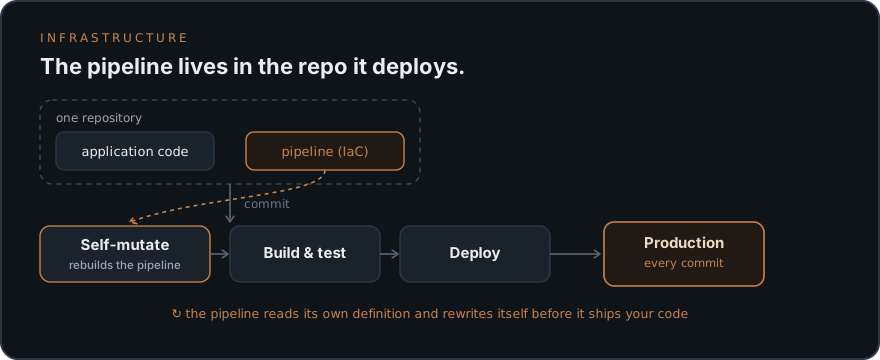
On every engagement we shorten the distance from merge to production first, before we optimize anything else. In practice that means pipelines defined in the repo they deploy, feature flags as a default rather than an exception, and an explicit agreement with the client about who decides when code ships.
The economic argument is the one that wins the room. Engineers already believe shipping often is better. The people who need convincing are weighing capital and risk, and to them, a backlog of unshipped work is money that has been spent and is not yet doing anything.
Want to know how much finished work is sitting unshipped in your pipeline? Start a conversation.