
Senior on every engagement
Why we don't subcontract senior hours through staffing intermediaries — and what changes when the architect who scoped the work is the one who ships it.
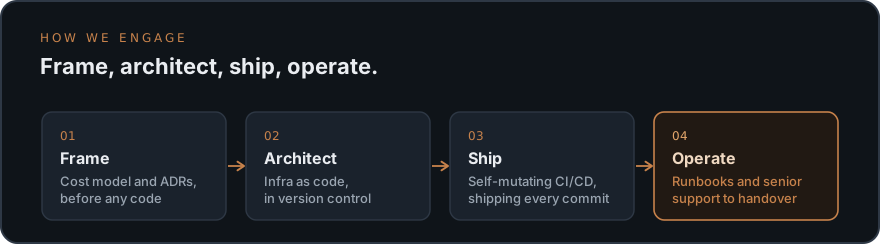
Here is how the bait-and-switch works in technical services, and almost everyone in the industry knows it works this way. A senior person shows up to win the engagement. They're sharp, they ask the right questions, they earn your trust, and they sign the deal. Then the work begins, and the senior person is gone — off winning the next deal — and the actual delivery lands on a rotation of junior staff, often subcontracted through a staffing intermediary you never met and never agreed to. You bought the architect. You got the staffing agency.
We don't do this. When you hire Ironwire, the Cloud Architect is on the engagement — not in the kickoff and the closeout, but in the work. This is the most important sentence on our site, and the entire structure of the firm exists to make it true.
Why most firms can't make this promise
The reason the bait-and-switch is so common isn't that everyone is dishonest. It's structural. A firm that takes a wide set of engagements needs a lot of hands, and senior hands are scarce and expensive. The math only closes if the seniors are leverage — selling and overseeing — while juniors and subcontractors do the building. So the senior person genuinely is on dozens of engagements, which means they're meaningfully on none of them.
The staffing-intermediary layer makes it worse. When senior hours are subcontracted in through an agency, there's a margin stack and a coordination layer between you and the person doing the work, and the person doing the work has no durable relationship with either the client or the firm whose name is on the invoice. Nobody in that arrangement is positioned to carry the thing end to end.
How we make it true: stay narrow
Our answer is the boring one. We keep the practice narrow. We run a small number of engagements at a time, deliberately, so that the senior person who scoped the work can actually do the work. The "what we say no to" discipline isn't separate from this promise — it's how the promise gets kept. You can only put the architect on every engagement if you don't take more engagements than the architect can be on.
When we need a larger collaborative bench, we partner — openly, with a named firm like Watkyn, where each side retains its own brand and books. That's a partnership you can see, not a subcontracted body shop hidden behind our logo.
What changes when the senior person ships
The benefit isn't seniority as a status symbol. It's continuity of judgment. The person who understood why a tradeoff was made is the person who lives with the tradeoff. The context that usually evaporates in the hand-off from sales-engineer to delivery-team never has to survive a hand-off, because there isn't one. Decisions are consistent because one mind made them and stayed. When reality contradicts the plan — and it always does — the person responding is the person who made the plan, and can adjust it intelligently rather than defending someone else's deck.
There's a cost to you, and it's honest: a narrow practice means we sometimes can't start when you'd like, because the architect is genuinely occupied elsewhere. We think that's the right trade. A firm that can always start immediately is a firm with a bench of idle juniors waiting to be assigned to you. We'd rather you wait a little for the real thing than start tomorrow with the wrong one.
You hire the architect. You get the architect. The whole firm is built around keeping that simple.
Want the senior person who scopes your work to be the one who ships it? Start a conversation.